
East Windsor Previous Residents by Era
For East Windsor previous residents, begin by matching the date range to the source. The Mercer County Clerk describes its land-record collection as reaching back to the county's 1838 incorporation, although the county does not state a first year for online images. Tax products can supply annual assessment context. Directories and censuses add dated household leads, while newspapers and maps can supply context when a name or street changes. None is a master list of who lived in a house.
| Source | Years it covers | Where held | What it can show |
|---|---|---|---|
| Mercer land-record collection | Documents since 1838; online-image cutoff not stated | Clerk public search and Records Room | Recorded conveyances, parties, legal descriptions, maps, liens, and mortgages |
| Mercer tax and assessment products | Annual or current tax-list series; public backfile not stated | Board of Taxation and East Windsor Assessor | Alpha and Street Index entries, tax cards, sales, and assessment context |
| East Windsor tax-bill account | Current and prior three years stated by the township | Township-linked tax-bill portal | Billed party, account status, and property identifiers |
| Regional directories and Criss-Cross volumes | Polk 1901-1958 online with gaps; other runs vary | Princeton Public Library, HeritageQuest, and NJ State Library leads | Dated name, address, telephone, and reverse street listings |
| Hightstown newspapers | Verified title runs begin as early as 1846 and extend into later decades | Digifind-It, MCLS, and HEWHS | Notices, obituaries, estates, organizations, and street mentions |
| Sanborn and census records | Sanborn years 1885-1925; released census years vary | Princeton collections and library microfilm | Building context and point-in-time household evidence |
The New Jersey State Archives genealogical collections are a useful next custodian when a Mercer or local library trail reaches older state, county, court, or microfilm material. Their records have their own date and access rules, so record the source date as carefully as the address.
The Archives route broadens a house-history search beyond a current parcel without turning a historic lead into proof of present occupancy.
Note: Keep a separate date, place label, and evidence role for every entry in an East Windsor previous-residents trail.
Parcel First for East Windsor Past Residents
A current street address is a starting label, not the strongest historic key. The Mercer ArcGIS service exposes current parcels, roads, blocks, buildings, municipal boundaries, and a PAMS_PIN identifier. The county says public parcel-owner names are redacted, so use the geometry to capture the parcel relationship and then consult the separately kept deed and assessment records. The county's public Property Information Portal is closed to general public access under its stated Daniel's Law restrictions.
For an East Windsor address, normalize the street number, street name, suffix, unit, municipality, and ZIP. Preserve the older spelling or place name in a second field. The East Windsor Tax Assessor maintains parcel records, the tax list, and a community tax map. Mercer Board of Taxation products identify an Alpha Index for owner names and a Street Index for properties by location, though the inspected sources did not provide a current public field-by-field interface.
A tax bill is not a residence record. It may identify a billed party or mailing contact for a tax year. Write down the tax year and displayed property identifier before treating it as a lead for past residents.
East Windsor Previous Residents in Deeds
The Mercer County public deed search is the ownership backbone for an East Windsor previous-residents search. It supports town, block and lot, party name, instrument number, book and page, legal description, date range, consideration, and other fields. Select East Windsor for current records, but test Hightstown when the document date and historic jurisdiction suggest it. The portal's party format is last name followed by first name, with no comma.
- Capture the present parcel identifier, block and lot, municipality, and any legal-description wording from the assessor or tax record.
- Search the Clerk index for the current recorded party or the block and lot, then save the document date, instrument number, book and page, and parties.
- Use the earlier party and legal description to find the preceding conveyance. A grantor is the party transferring an interest; a grantee is the party receiving it.
- Repeat the link backward, logging deeds, mortgages, liens, corrections, and replaced-record notices rather than assuming every document is a sale.
- When the web result lacks an image or the date is earlier than the accessible result, use the Clerk Records Room or ask staff about the index and copy procedure.
- Chain of title
- A dated sequence of recorded conveyances and related instruments connected to the same property.
- Legal description
- The parcel wording used in a recorded instrument. It often survives when a street label changes.
- Block and lot
- Local parcel identifiers that help connect a tax or map record to the Clerk index.
- Recorded owner
- A party shown in a property instrument. That status does not by itself prove who occupied the address.
The Clerk's results can flag replaced records with R, correction records with C, and some party records as not verified. Preserve those markers in the research log. The Clerk Records Room at 209 South Broad Street in Trenton is open Monday through Friday from 8:30 a.m. to 4:30 p.m. according to the county, and staff can familiarize visitors with the computerized systems but do not perform title searches.
Tax Years Behind East Windsor Previous Residents
Mercer's Board of Taxation names property record cards, sales, deeds, tax information, Tax List Proof Book, Alpha Index, Street Index, District Summary, Mod IV Sales, and Deduction Report among its public information products. The Street Index is the useful location-oriented product after a known address has been normalized. The Alpha Index can help locate an owner name, but it remains a tax-record role, not a household roster.
The township-linked East Windsor tax-bill search accepts owner and property number or street searches, among several account identifiers. Its instructions say to omit a street suffix and use abbreviations in the street field. The township says tax-account history covers three years. Use the displayed bill status and year as context for the property trail, then return to the deed index for the recorded conveyance.
Note: A change in billed party, assessment, or mailing address needs a matching document before it is treated as a change in residence.
East Windsor Past Residents in Directories
Ownership is only one layer. Princeton and regional directory resources can identify a person printed at an address for a particular edition. Princeton's Polk directories cover 1901-1958 online with gaps, and the library also identifies a physical Polk run beginning in 1916-17 and continuing to 1982 with gaps. Princeton/Suburban Trenton Criss-Cross editions can include Hightstown and Cranbury and are organized by telephone number and street address, making them especially useful when a surname search fails.
Use the East Windsor city directory page for the collections themselves. For a house trail, record the volume title, publisher, edition year, place coverage, printed address, and any abbreviation key before comparing nearby editions. The research did not locate an actual Hightstown directory-entry image, so expected directory fields should not be reported as an observed local entry.
- Choose a directory year near a deed or tax-record date and confirm that the volume covers the relevant place.
- Search both the surname side and the street or number side in a Criss-Cross volume when available.
- Compare the preceding and following available editions, marking a first appearance, last appearance, address change, and all missing years.
- Pair the dated address lead with the appropriate released federal or New Jersey census schedule, preserving the census geography and enumeration date.
Census material is point-in-time enumeration evidence. Princeton's guidance identifies Mercer federal and New Jersey census microfilm holdings, including 1910 Mercer material for East Windsor and Hightstown. The 1950 federal census is the latest released under the 72-year rule as of 2026, while 1960 is not yet released.
East Windsor Previous Residents in Notices
The Hightstown digital archive offers keyword and document searches across local newspaper titles. Search the exact street and surname first, then try spelling variants, Hightstown, East Windsor, Etra, organizations, churches, and cemeteries. Inspect the issue date, page, and nearby notices. A snippet may point to an obituary, estate sale, civic item, or advertisement, but it does not establish the full relationship on its own.
The Mercer County Library research example from 1916 connected an obituary with an estate-sale notice and a church-committee item. That kind of cluster can extend a house-history timeline, especially when an estate or probate term appears beside a street reference. It should be labeled as a notice or mention, not converted into proof that everyone named lived at the address.
Historical newspapers also reveal gaps. The digital archive lists the Hightstown Gazette from 1852 to 2006, while an MCLS source describes a final issue in 2005. Keep the source statement with the exact issue consulted rather than forcing one continuous run.
East Windsor Previous Residents and Hightstown
Historic jurisdiction labels can break an otherwise sound search. Hightstown incorporated from East Windsor in 1853, and official borough history lists later East Windsor portions annexed in 1913, 1915, and 1927. A deed, newspaper, directory, or map can therefore use Hightstown when a modern parcel is associated with East Windsor. Compare the legal description, block and lot, map, landmark, and record date before deciding that the entries refer to different places.
The East Windsor township history preserves local place context, including the 1875 map and references to Etra, Dutch Neck, Wyckoff Mills, and older road names. It is useful for reconciling place labels, not for identifying a current household.
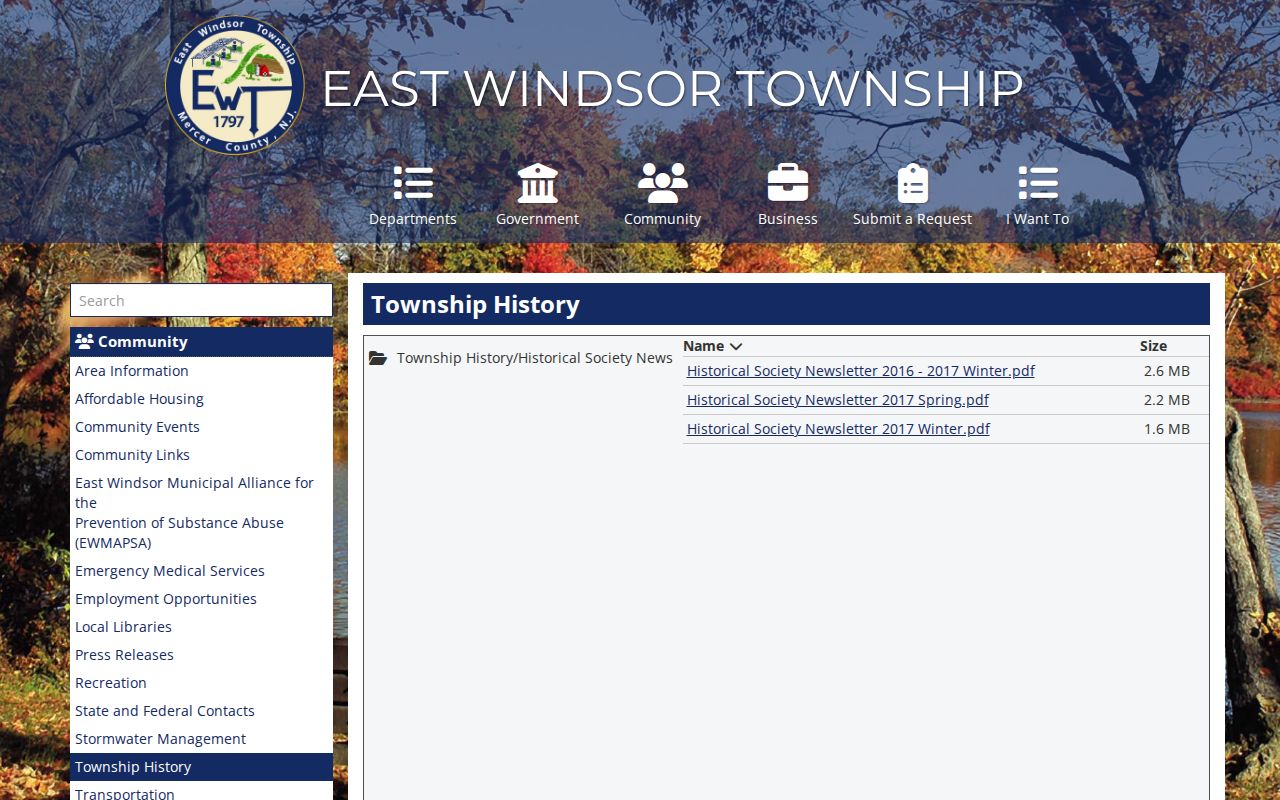
The township-history material helps explain why a past address can appear under a different local label before the parcel trail is evaluated.
Note: Preserve the original place name in the record log even after a parcel or map supports a modern East Windsor match.
Sanborn Context for East Windsor Previous Residents
Sanborn maps add a building and site layer to a previous-residents search. Princeton's Hightstown inventory lists selected sets for 1885, 1890, 1895, 1902, 1910, 1916, and 1925. Start with the index sheet, retain the map year and sheet number, then compare the street layout, footprint, stories, use, materials, and fire-related symbols with the dated property trail.
A Sanborn sheet can show that a site or building form existed in a map year. It does not name a household. Use it with a deed, directory, census, or newspaper source that carries a date and relationship. HEWHS, whose library holds local newspapers, maps, books, and other material dating to the mid-1800s, is the local archive contact when an address requires more context.
Lawful East Windsor Previous Residents Research
Use East Windsor previous-residents research for house history, family history, estate questions, or a documented historical record trail. Mercer and state custodians keep different records and access rules, so an absent online result can mean a different office, a restricted record, a missing edition, or an unscanned image. Mark that limitation and use the documented fallback rather than making an unsupported match.
Lawful use. Keep house-history research focused on documented records and public context. Do not use names, address leads, or record gaps to stalk, harass, intimidate, or harm any living person.